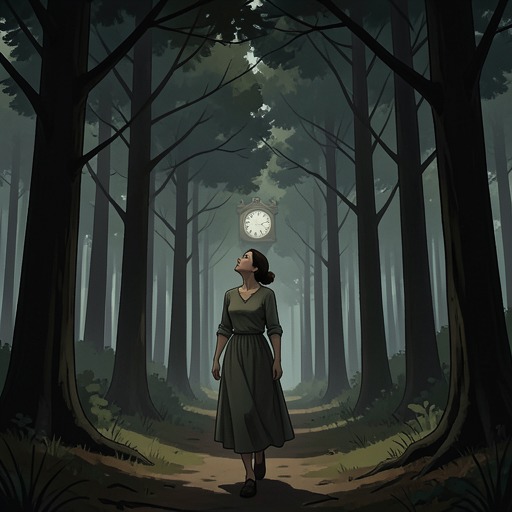
Athanasia Malavas
Cartes Postales from GreeceAthanasia Malavas’s journey to her father’s village turns Arcadia from an imagined paradise into a test of what inheritance, belonging, and freedom can mean for a woman. She arrives seeking a grave and fragments of family history, but the landscape’s celebrated beauty cannot answer her questions or make the village welcoming. Her departure, running beneath the rising moon, gives her brief return its decisive meaning: the place she hoped to understand becomes somewhere she must escape.
Identity and Family Background
Athanasia grew up in Athens amid the city’s dust and noise. She loved it and had felt little desire to discover what lay beyond it. Her name means immortality, a meaning set against the story she has inherited: her father, Grigoris Malavas, died when she was two, leaving her with no memories of him. In her childhood he was rarely discussed. There were no photographs or other evidence of his existence in the family home; as the narrative puts it, she was the only thing left behind.
The silences extended beyond memory. When Athanasia’s mother died the previous year, Athanasia sorted through her apartment and found no marriage certificate, wedding photograph, or letter bearing both parents’ names. Even the wardrobe contained nothing black. The absence of these ordinary records leaves Athanasia with a father who is both a fact of her birth and an almost undocumented figure. Her search begins, therefore, not with a clear family account but with a set of missing traces.
Her knowledge of the village is similarly narrow. Her mother left after Grigoris’s forty-day memorial, and the family never returned to mark the later anniversaries of his death. Much later, her mother said only that her father’s brother had done what was necessary. From this Athanasia knew she had an uncle, but not whether he was still alive. The remark hints at past help without explaining what happened, giving Athanasia a reason to seek the village while leaving the central family history unresolved.
The Return to Arcadia
At twenty-eight, curious and independent, Athanasia chooses to travel to the village where she was born, high in the mountains beyond Kosmas. She has no childhood memories of the place. Her destination is at once personal and idealized: she wants to visit her father’s home region, find out whether the claims made about Arcadia are true, and test the idea that it is the most beautiful place on earth. The journey thus joins a practical search for a grave to a larger question about the landscape she has been taught to imagine.
At first, the scenery appears to confirm that ideal. As she follows the winding mountain road, she stops to look across the valley toward Mount Parnonas. The cool, clean air is intense enough to make her lungs burn, and the view seems more beautiful than the paintings inspired by it. This response is not dismissed as false: the landscape really does possess the grandeur that drew her there. But its beauty proves distinct from the human welcome Athanasia needs. The contrast between an admired place and the life available within it becomes the journey’s governing tension.
The Village and Her Departure
When a man confronts her with the question of why she has come, Athanasia explains that her family came from there through her father. He continues peeling and eating chestnuts, showing no interest in her answer. She then makes the purpose of her visit explicit: her father died, her mother left, and she would like to visit his grave. The exchange gives her search a concrete object, but the man’s indifference offers no help or recognition.
The wider reception is equally forbidding. Athanasia finds herself among impassive faces in an atmosphere of smoke, silence, and palpable hostility. She thinks of the only woman she has seen that day, a shepherdess who, in Athanasia’s reading, had been obliged to become like a man in order to survive. She wonders whether the other women have long since left, as her own mother did. Her thought connects the family’s departure to a wider gendered condition in the village, though the narrative presents it as Athanasia’s interpretation rather than a complete account of the community.
By this point, she understands that she has to leave as soon as she can. As the moon rises, she begins to run. The account does not resolve whether she finds her father’s grave, whether her uncle is alive, or what further knowledge she might have gained by staying. Instead, it ends this episode with motion away from the village. Her conclusion is stark: Arcadia is no place for a woman. The escape is not a discovery of the family history she sought; it is a refusal to remain in a setting she experiences as hostile and constraining.
Paradise, Gender, and the Meaning of the Episode
The heading ET IN ARCADIA EGO, glossed as EVEN IN PARADISE, I AM THERE, frames the journey through a deliberate contrast. Arcadia’s reputation and scenery evoke a place of exceptional beauty, while Athanasia’s encounter makes clear that beauty does not guarantee safety, welcome, or belonging. The landscape can approach the ideal she has heard about and still fail to offer a viable home. The episode’s force comes from holding those two truths together rather than exposing the natural beauty as merely an illusion.
Athanasia’s search also makes family silence tangible. Her father is absent from photographs and documents, her memories cannot supply what was never shared with her, and her mother’s single explanation identifies an uncle without making him accessible. The hoped-for grave represents a possible point of contact with this missing history, but the village encounter interrupts the search before the account can show what she finds. In this way, the episode leaves her family questions open while making the immediate consequence of her visit unmistakable: she chooses departure over remaining in a place where she feels a woman cannot live freely.